Posts

Showing posts with the label creative process

A Profound Quote to Start the Year

Image
"In these times there is a powerful demarcation between the surface and the deep currents of human development. Events and upheavals, which seem more profound than they really are, are happening on the surface. But there is another and deeper change in progress. It is a long, steady persistent growth, very little affected and not at all disturbed by surface conditions. The artist of today should be alive to this deeper evolution on which all growth depends, has depended and will depend." Robert Henri, The Art Spirit ( originally published 1923 ) This year I'm adopting the "Dry January" theme and applying it to my use of technology. How much unproductive time I've been wasting with it! Only a few days in, but I've put aside  iPad  games and am staying up to date on news through headlines or occasional articles rather than gathering information that will be out of date in the next 24 hour news cycle. (Perhaps that's why this quote seemed to strike a c...
Interview on Create Whimsy

Image
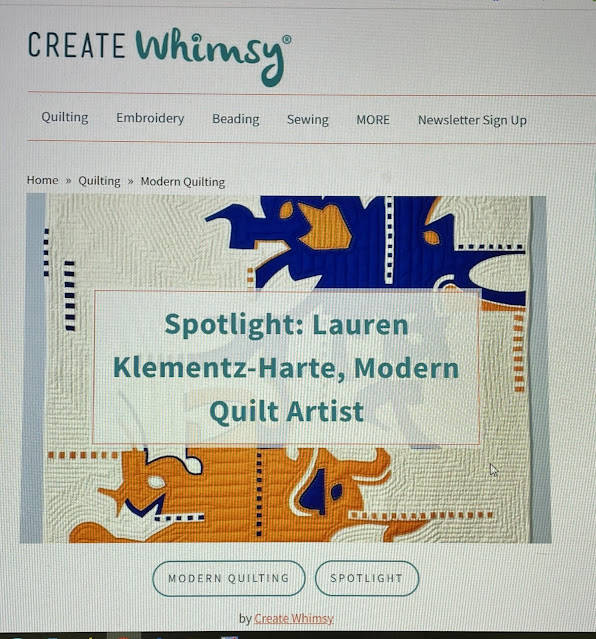
I'm excited to share the news that my work, (& I) are featured in the "Latest Stories" section on the Create Whimsy website,  https://createwhimsy.com/ . It was such a joy to collaborate with Create Whimsy founder, Lynn Woll on this project. She had great, thought provoking questions for my interview!  It was especially meaningful to be asked about my personal philosophy on my work and to promote handwork in the realm of quilting. (It's not every day someone asks you for the best advice you've ever gotten!) Check it out with this link: https://createwhimsy.com/projects/spotlight-lauren-klementz-harte-modern-quilt-artist/   But don't stop there! You'll want to explore this resource. Create Whimsey is a cool website that gives a platform to artisans in many different mediums and also has tutorials, project ideas, free quilt patterns, just so much for the person who loves to be creative! Many thanks to Create Whimsy for the opportunity to contribute to th...

Basics of Reverse Appliqué

Image
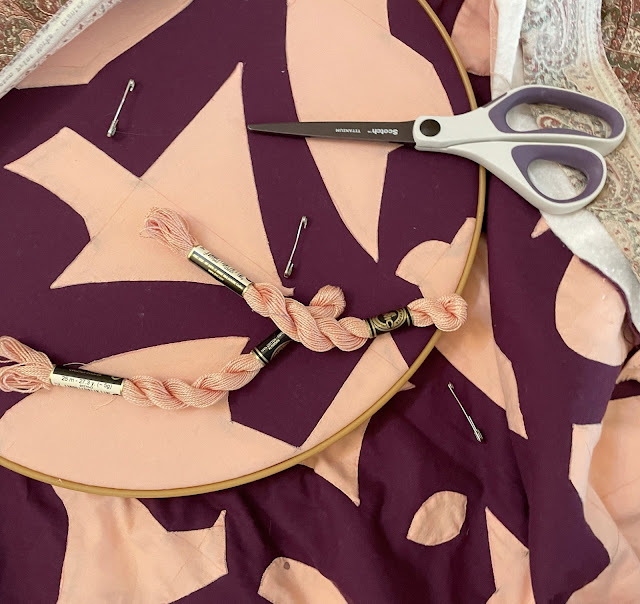
Travel Project Near Completion The hand work project that I took on vacation is in the quilting phase of the process now. I anticipate being able to reveal the final piece next week. In the meantime, I thought I'd give a general overview of the reverse appliqué process. The first thing to understand is the difference between appliqué and reverse appliqué .  Appliqué is essentially an adding process; a shape is cut from one fabric and sewn in place on a second background fabric.  Reverse appliqué is basically the opposite; it is a subtracting process. The supply list for this technique is very short: two pieces of fabric (with the same dimensions) and thread. The only other things needed are a needle for hand sewing, a good pair of scissors, and lots of time and patience. This makes it an ideal travel project, assuming you are checking your bag with the scissors when you travel.  Step 1   Shapes are drawn out on the background fabric, as if drawing on a piece ...

New Goal: Catching Up on the Last Step

Image
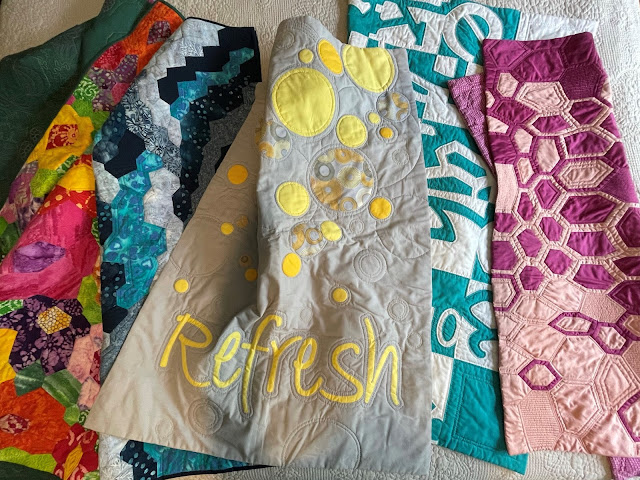
Labeling Quilts This week I was refolding a stack of quilts that had been piled up on an extra bed and I noticed there are quite a few that are not labeled. It seems lately I've been so focused on designing and executing new ideas that, as soon as the last binding stitch is tied off, I move on to the next project. No wonder I had this nagging sense of unfinished business with these quilts! Very often when I've run across an unsigned, unique, and appealing quilt in a history book I'm left with mixed emotions. On the one hand, I'm grateful to have documentation of quilts from all moments in time. It's wonderful to be able to draw inspiration and lessons from generations of quilters for our own work! Still, it leaves me wistful that historians are left to play investigator and speculate on the quilt's origins and creator. Today it is recommended that quilters label their work with their name, date, perhaps a title or an indication of the pattern name, and even the ...

Gift Giving for the Artisan in Your Life

Image
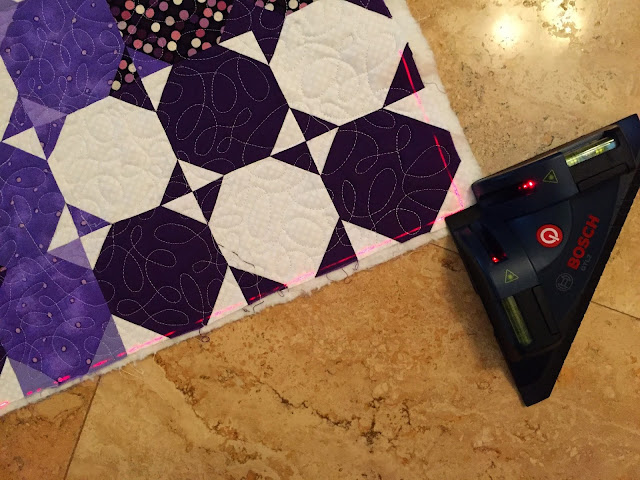
Creative Problem Solving Bosch Laser Square GTL2 Anyone in a position to observe a creative person in their natural habitat gradually becomes acquainted with the tools they employ, the terms they use, their work habits and their joy in creating. It would be natural to assume that, if an artist is continuously creating, they have "all the bases covered," and it's better to steer clear of this area when it comes to gift giving. But the gift giver has an opportunity to use their own creativity to think outside the confines of what is comfortable and familiar to the artist, to bring a fresh perspective, and find something special for the artisan in their life. Start with asking two simple questions:                   1) What is your favorite part of your creative process?                        and                   2) What is your l...

Inspiration from Chefs (3 of 3)

Image
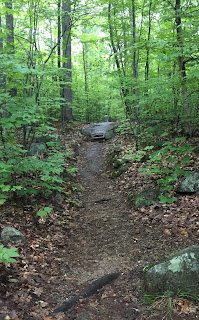
Inspiration from Chefs (3 of 3) Finding a path through the woods I was hooked on  Chef's Table after the first episode of season one, when we become acquainted with Italian chef Massimo Bottura, of the three Michelin star restaurant  Osteria Francescana in Modena. While sharing his history, Massimo recalls when his future wife introduced him to the world of art and describes his impressions and reactions to what he saw in the museum. Moved by the experience, he tells of wanting to bring that aesthetic to his work. In essence, he stepped out of the familiar and was open to what this new environment had to offer.  This was a turning point in his career.  It is a wonderful narrative of being inspired by an outside influence, and letting what you see and feel from that experience inform the work you love.  But, keep in mind that this was after years of developing the skills of a chef. He had already grasped some of the possibilities of what ...

Where Does Our Inspiration Come From? (1 of 3)

Image
Where Does Our Inspiration Come From? (1 of 3) If you enjoy the creative process, no matter what medium you are working in, you are probably always anticipating your next project. What will your next creative challenge be? I've been thinking a lot recently about where we can look for inspiration to improve and expand our creative endeavors. There are several obvious answers to this question. In this age of spontaneous sharing and the internet there is a rich store of images and instances of people's creativity. You have only to type in a very specific description of the project you want to create and up comes a multitude of examples of what has already been done. Likewise there are probably dozens, if not hundreds of magazines, self-help books, and classes which focus on the exact skill you are pursuing. They are all great starting points to refine techniques, build competence, and develop an appreciation for the possibilities and limitations of a given discipline. ...
Image
Reflections of an Art Student ( 4 of 4)   A Visual Travel Journal Enter the “critique”, where everyone lines up their work in front of the class for everyone else to see…and evaluate. Then one by one each artist is identified with their work, the professor makes  observations and recommendations and the rest of the class is able to contribute their input. There is a give and take in the conversation, an exchange of ideas. My guess is that this is still the way art classes work, because, at it’s best, it is a very productive way to learn and grow. It can also be very emotional. Studies from an art guild model session At turns the “crit” can be exhilarating and humiliating, discouraging and encouraging, positive and negative, and all together draining. When students in other fields get back a marked up paper or a test with an unexpected grade, they have the luxury of a private moment to deal with whatever emotions this feedback churns up. Not so the art student...
Image
Reflections of an Art Student   (3 of 4) More sketchbook drawings So, this was a revelation, the fact that there are adults out there who have held on to the impression they had in college that art was a less “serious” major. Like all false impressions, undervaluing the art student (or anyone else) starts with a quick initial assessment: “that person is not like me”, which in many instances is followed by “… so they are weird…”. Then we look for things to support that analysis. But it would be a pretty boring world indeed if we all had the same interests and talents. To begin building bridges of understanding and mutual respect between people, it helps to examine what we have in common. Let me provide some perspective. One thing we all have in common is the desire to pursue our interests and refine our talents. I didn’t know anyone planning to go from high school to college who wasn’t looking forward to the freedom of not dealing with subjects they didn’t p...
Image
Reflections of an Art Student   (2 of 4) A page from my travel sketchbook It wasn't until three or four years ago that it occurred to me that people might not think of a degree in art as much of an accomplishment. I was having a conversation with a friend whose child was choosing to get a bachelor of arts degree and she asked me if I ever felt judged for only having a degree in the arts. Now, I'm not going to say that I was unaware of people in college who dismissed the arts and, by extension, the study of them. But I really never thought that attitude would find footing after I left the sheltered halls of collegiate life. Let's face it, though the college experience can be mind expanding, you're still dealing with a very young adult community that has extremely limited real life experience. One might expect more of people once they are exposed to the "real world". As for me, I always assumed that everyone who took the time to study any subject wa...
Image
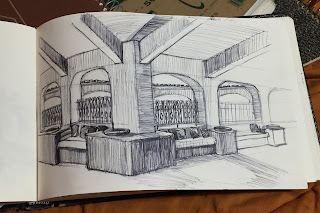
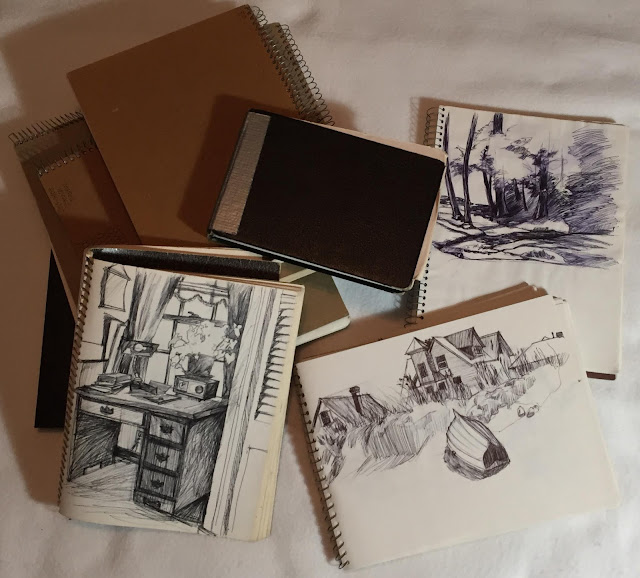
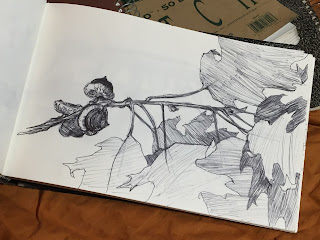
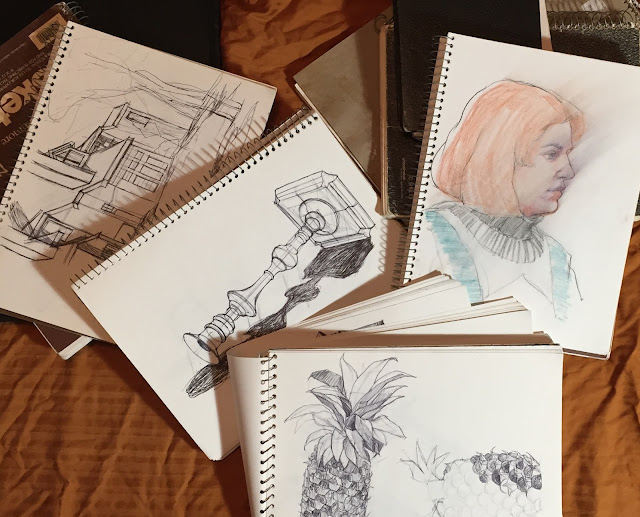
Reflections of an Art Student    (1 of 4) Rummaging around in the closet, I came across a bunch of old sketchbooks that span several years of my art work after college graduation. They are filled with drawings of people, places, and things; vacation destinations, views from a window and every day items. I suddenly had a flashback to the first day of drawing class. As we fresh faced, eager freshmen began our college careers, the professor soberly informed us that we might as well come to terms with the fact that "99.9 percent of the work you will produce this year" would end up in the trash can. After a moment of stunned silence, he then reassured us that it would all be worth the effort when we produced that .1% that was really good. When I look through these sketchbooks, I can see the process unfolding. I see the stumbling, mistakes, and corrections in the rough sketches, which document how I was translating what I saw to the two dimensional surface. All neces...
Image
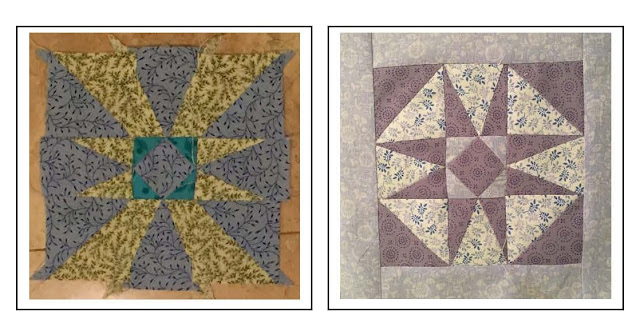
One Last History Note  (4 of 4) These are two squares from my 2016 sampler quilt. The one on the right is the original pattern from  Laurie Aaron Hird's,  The Farmer's Wife's 1930's Sampler Quilt .   On the left you see the result of not paying attention when sewing block units together.  They are made up of exactly same units... I just screwed up.  I wonder how many new patterns are a result of that kind of mistake. My last summer reading,  Soft Covers for Hard Times  by Merikay Waldvogel, gave me even more perspective on quilting history. You see, until the early 1900's quilt patterns were shared within families and communities, friend to friend, quilter to quilter, and even if they thought to name a pattern, the name would have significance to that community or region. In pre-industrialized America, a single piecing pattern could have several names. Quilt making received a creative boost in the 1920's with the Colonial Revival wh...
Image
Sampler History (3 of 4) One of my knitting buddies just shared that she had started a new project with an unfamiliar pattern. Before beginning the full project, she took the time to knit through the pattern in a smaller portion as a trial run. She was taking part in the age-old learning method of the sampler. Assuming she didn’t pull it all out to incorporate the yarn into her project, she now has a square of this pattern. I’ve learned from my summer history reading that this is how some sampler quilts came in to being. It turns out that the sampler quilt in the form that I’ve been practicing- gathering various blocks to try them in coordinated fabrics and setting them in a quilt, might be a relatively new phenomenon. Perhaps it has gained popularity with books of pattern collections which include an example of a sampler option that incorporates all the pattern blocks in one quilt... a final “ta da!” moment at the end of the book. This sampler quilt was inspired by L...
Image
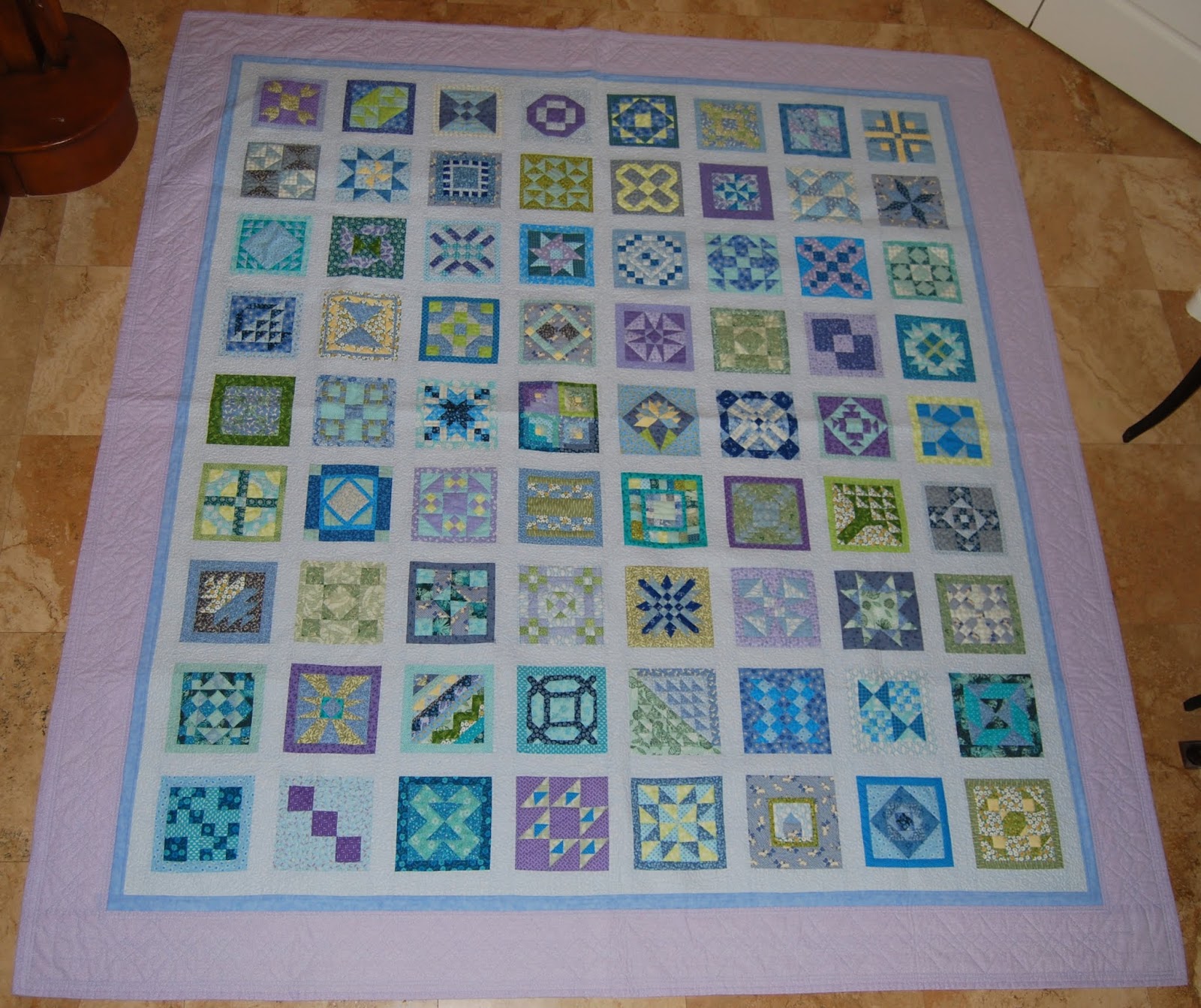
Another conversation about quilting   (1 of 3) When my daughter met her friend’s mom, she came home to tell me that she thought we’d get along well because we had so much in common, and especially because we both quilted. Naturally, I was looking forward to meeting her at a little gathering recently. She turned out to be a lovely, warm person. I brought up our mutual interest, when we finally had the opportunity to chat. She responded that she really enjoyed sewing the tops of quilts, but she didn’t really like the quilting part… in other words she didn’t like to finish them off. “Ah Ha!”, I thought, “I totally get where you’re coming from!!!” I've developed the quilters' habit of picking up fabric for my "stash",  sometimes  with no clue as to how it will be used... but it will be used eventually. It wasn’t that long ago that I felt exactly the same way. Finding a pattern to try, deciding on a color scheme, pulling all the fabrics together… in othe...
Image
Decision Made All the blocks are together and it's ready to be quilted. Currently, I have four quilting projects going on, all at various stages of completion. Guess I better get back to work, so I have something to show you...
Image
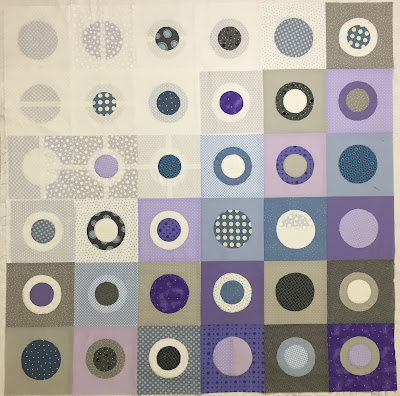
Now what? I opted to keep this to wall hanging size, with 36 squares. For me, the biggest challenge comes when all the squares are complete, the stage when they have to be joined together.  When you happily sew square after square, without an overall plan, well, you get what you get, and then you have to deal with them. At this stage, I spread out what I have, to get an overall view. (If you're happy with the way they come together the first time, good for you! Celebrate! That's never happened for me.) Then I begin sorting the squares into groups. It might be light/medium/dark, or it might be by background color dominance, or some other characteristic that I want to highlight. You could probably come up with some categories I hadn't even thought of... I usually end up spending lot of time and energy before deciding on the final version, but this time seemed to go a bit quicker- perhaps because it is a smaller size. In this case I experimented with random placem...
Image
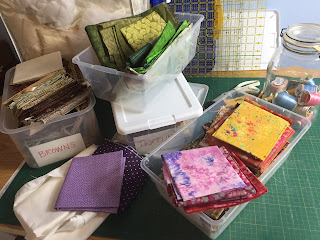
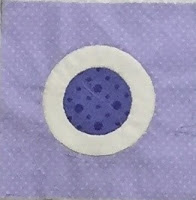
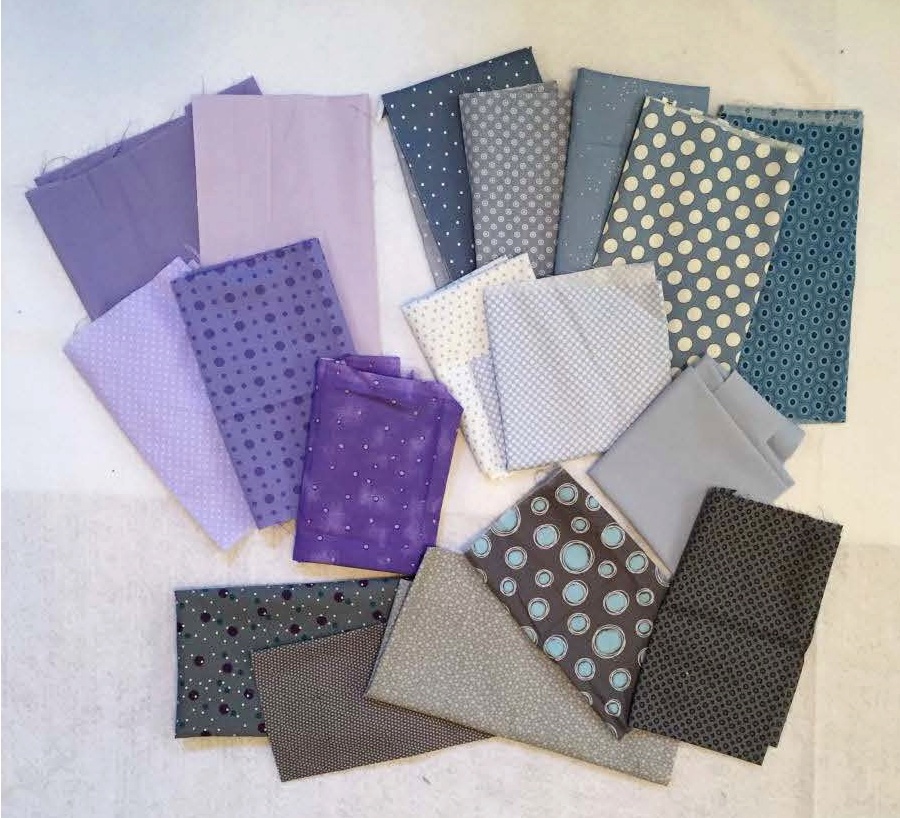
Have Project, Will Travel Of course, I could not go on a trip east without a hand project. I suppose because I know someone who really likes polka dots, I had been noticing a lot of them in the fabric stores lately. I started picking up a few pieces in the cool color range-greens, teals, blues, purples and greys. The project I settled on was a series of appliquéd squares in the blues, greys and purples. This technique involves sewing a cut fabric shape onto a larger piece of fabric using an invisible stitch and folding under the raw edge for the finished look. And could there be a more fitting shape for polka dots than a circle? My appliqué skills will always need improvement. But there's only one way to fix that... Practice, practice, practice...
Image
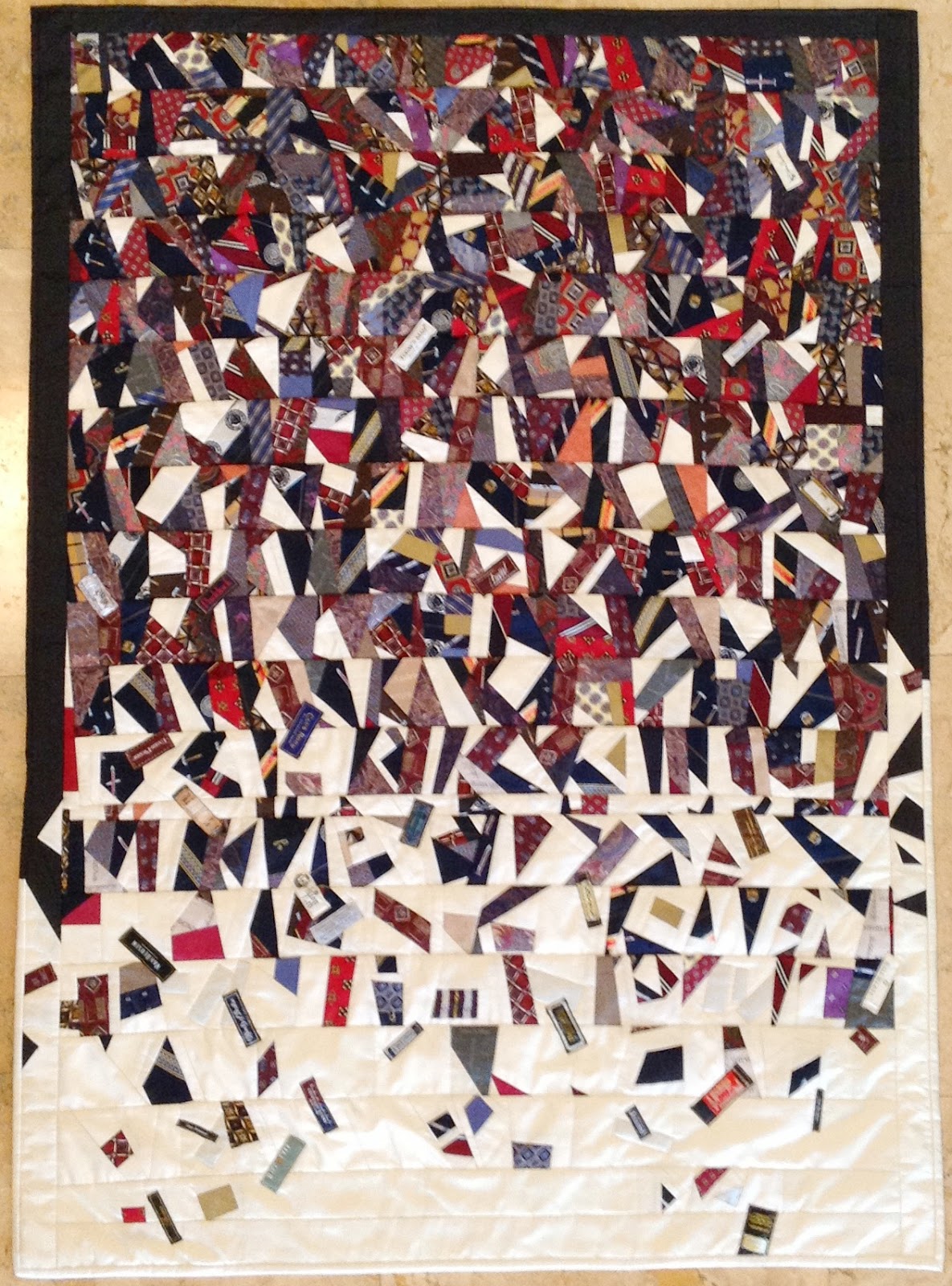
Aaaaand....Ta Da!      (5 of 5) I wish I had taken a photo of all the scraps left after 3 wall hangings and a lap quilt. 36 neckties and several yards of cream silk = piles of thin strips, awkward triangles, little squares and other shapes that defied labels. Anything that couldn't support a durable margin for seaming, and still show off at least a half inch of fabric, found its way to the circular file. What remained seemed really precious to me; 1) because it was from my dads ties, and 2) because I can be, well,... um, what's the right word here?...frugal. Even with my trusty coupons, that silk was a small fortune.  I couldn’t bring myself to throw out any of it.  Why not put it all to good use? What came to mind was the quilt you see in the banner of this blog, (special thanks to my quilting buddy Sara for the idea/tutorial):                       Front and back- use up all tha...
Image
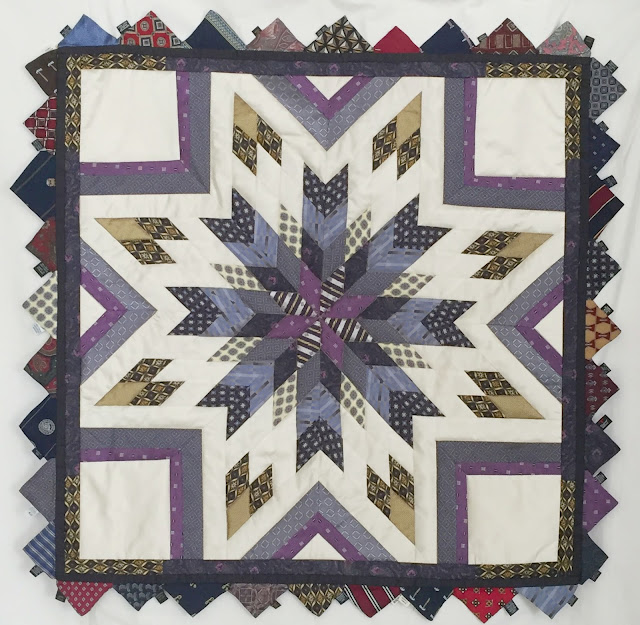
Really? Another Star? (4 of 5) Yeah. It really wasn't a conscious decision to keep doing variations on the star theme, it just kind of happened. This is a Texas Star. Working the diamonds in concentric circles from the center, it is usually solid to the points, a big burst of color. But I began sewing this wall hanging before I realized there wasn’t enough of each fabric to follow the traditional pattern. This is where photographing stages played an important part in the final outcome. The center was the easiest part, I just needed 8 diamonds. As I moved outward to the next levels, the required number of diamonds increased and my fabric diminished. You can also see that some of the choices would eventually effect the feeling of the quilt, making it look darker or heavier than other choices.  In the bottom left photo you can see where I compared a solid point to the point I chose...my judgement call. Perhaps you would have gone in the other direction....
“Wait, wait, don’t leave yet!” If you’re not really “into quilts”, I may have lost you by this time. So, let’s take a step back and make some observations.  Producing this quilt series was very similar to situations you face every day in your personal and professional lives. Suppose you get ready to make dinner at the end of a long day, but when you go to the fridge you find it isn’t as well stocked as you anticipated. Someone who loves to cook can create a yummy meal with next to nothing. Many a parent has uttered the words “Here, use this instead” when their child has informed them they are out of an important craft supply. In fact, if, in mid brush stroke, a painter finds the tube of turquoise has run dry, they use what they know about color to create a close match.   They might even decide to change the color all together. This is often how something really different comes along. I’ll bet you can think of several work situations where you were given a job with mu...